
Blog · Home Comfort · Technical references checked October 2026
When the downstairs feels comfortable and the upstairs stays hot, lowering the thermostat can become a daily routine. It may cool rooms that already feel fine while the bedrooms remain uncomfortable. The useful next step is to find where heat enters and how cooling reaches those rooms.
Attic insulation can be part of the solution, but a hot upstairs does not prove that insulation is the only problem. A careful review can help you spend money on the conditions that actually affect the space.
Start with the pattern
Write down which rooms get hot and when. Is the entire floor uncomfortable, or just a west-facing bedroom? Does the temperature rise in late afternoon? Is the room above a garage? Does closing the bedroom door make the problem worse?
These observations give an insulation or heating-and-cooling professional a better starting point. Keep a simple record over several similar days: thermostat setting, approximate room temperatures, outdoor conditions, and whether doors and blinds were open. Use the same thermometer and measurement locations for a more useful comparison.
Check the attic insulation
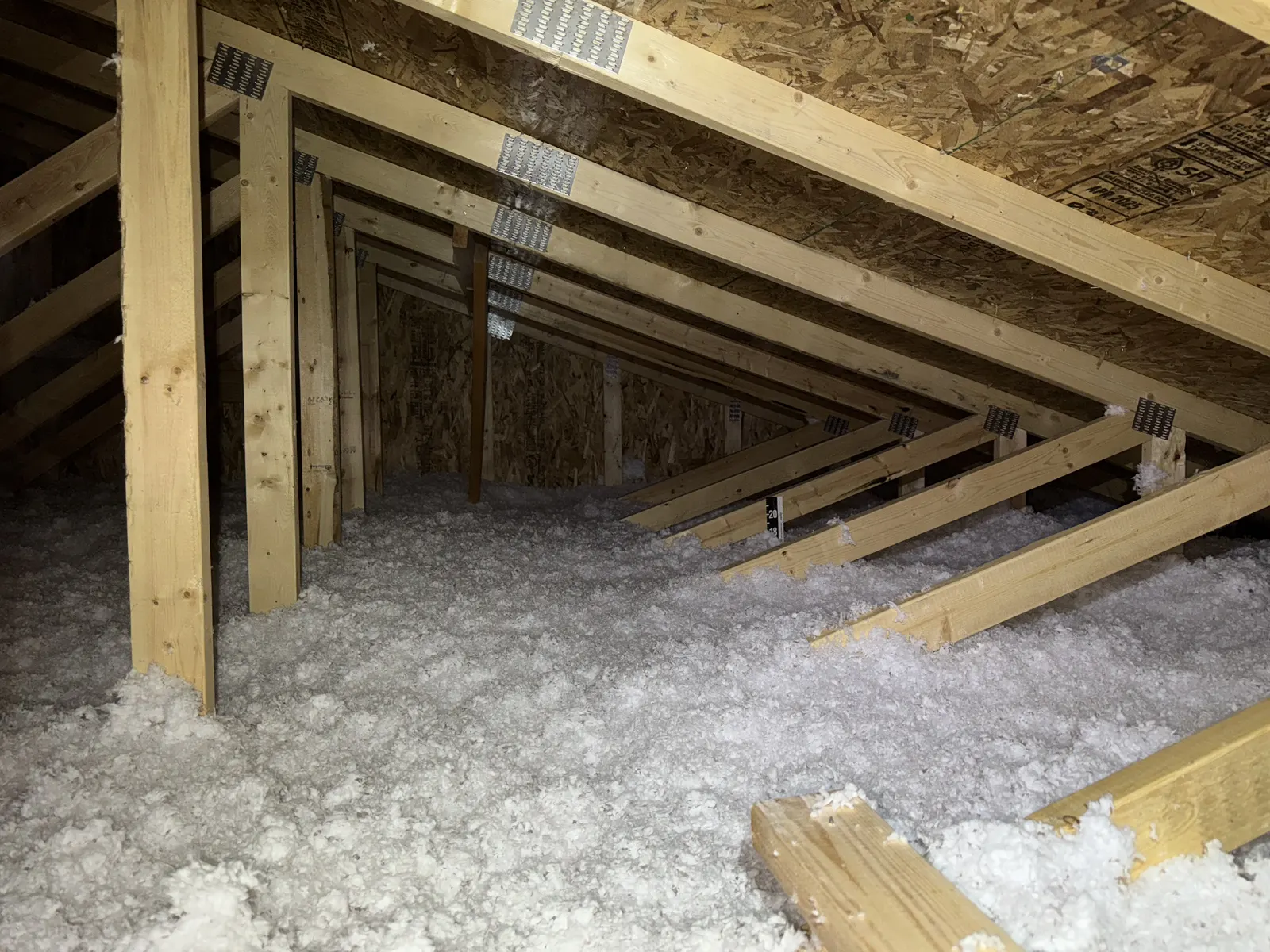
The attic floor separates many upstairs rooms from an unconditioned roof space. Low or uneven insulation can allow more heat to move through the ceiling. The issue may be a broad shortage, a disturbed area, or limited coverage near an outside wall.
A review should consider material, distribution, accessible low spots, and the insulation over the rooms that concern you. Visible depth alone does not establish an exact R-value. ENERGY STAR’s problem guide identifies uneven room temperatures as a reason to investigate both attic insulation and air leaks.
Look at air pathways separately
Ceiling penetrations, attic access openings, and gaps in the building’s air barrier can connect the living space with the attic. Insulation and air sealing perform different tasks, so the estimate should identify both where appropriate.
An infrared camera can help reveal surface-temperature patterns under suitable conditions. Interwest combines thermal imaging, when useful, with a visual review. A thermal image is a clue to investigate; it does not independently prove a hidden cavity’s exact insulation value or locate every air leak.
Have the duct system and equipment considered
For a forced-air system, cooling depends on delivering enough conditioned air and providing an appropriate return path. Leaking, disconnected, damaged, or kinked ducts can contribute to difficult-to-cool rooms. Ducts running through an unconditioned attic face different conditions from ducts inside the home.
ENERGY STAR’s duct guidance recommends checking duct performance when rooms are hard to heat or cool. An HVAC contractor can assess airflow, equipment operation, and duct repairs. Adding attic insulation does not repair a disconnected duct or correct an equipment problem.
Consider windows and the roof assembly
A sunny room can have a different cooling load from a shaded room on the same floor. Note large windows, afternoon sun, skylights, and any recent additions. Blinds or suitable shading may help identify how much direct sun contributes, even before larger work is planned.
Roof and attic ventilation also deserve review, particularly where openings are blocked or moisture is present. Installing an attic fan is not an automatic cure. ENERGY STAR explains that a fan can pull conditioned air from a poorly sealed home when attic intake is inadequate.
Build a plan around the findings
If the review identifies low insulation, an attic upgrade may be appropriate. If it reveals roof leaks, unsafe wiring, duct defects, or moisture, those issues may need another trade first. Ask for a written sequence so each contractor understands what must happen before the next step.
Interwest has completed attic upgrades in Orem, American Fork, and Draper. Those photographs illustrate the insulation work; they are not a promise that every upstairs comfort problem has the same cause.
For a useful first message, include your city, the affected rooms, when the problem occurs, whether the rooms are above a garage, and any known attic or HVAC history. Visit our attic insulation page or request an evaluation. The goal is a clear explanation and a scope that addresses your home’s conditions.
Browse more insulation guides · See completed local projects