
You can often add ceiling insulation after a basement is finished, but the process is different from insulating open framing. The first question is whether the joist cavities are accessible. Open ceilings allow netting and blowing before drywall; finished ceilings may allow drill-and-fill through planned openings.
Open ceiling: netting holds the insulation
With accessible joists, we net the ceiling with mesh or netting secured by staples. We poke a hole in each cavity bay and blow it full of insulation. The framing and obstructions are visible, and the netting supports the insulation until the ceiling finish goes on. This is the stage to discuss ceiling sound insulation when finishing a basement.
Your builder should coordinate rough trades and required inspections before the cavities are covered. Send the drywall date when you ask for an estimate, along with photos of the ceiling and the rooms involved.
Finished ceiling: planned access openings
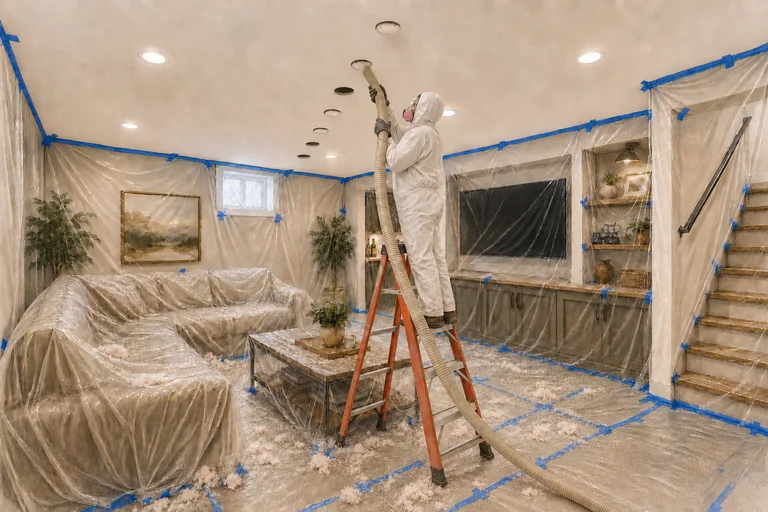
Drill-and-fill uses openings through the existing finish to reach the cavities. We review joist direction, blocking, existing insulation, ducts, plumbing, wiring, fixtures, and the condition of the ceiling. These details affect where access is practical and how fully a cavity can be treated. Some areas may need additional access or a different approach.
This method can avoid removing the entire ceiling, but it is not a hole-free installation. Ask where openings are expected, how the room will be protected, and what happens if hidden conditions change the plan. Old framing photos can be particularly useful.
Agree on closing and finishing
Closing an access opening and restoring a painted ceiling are different tasks. Your written estimate should identify who closes the openings, who handles drywall finishing and texture, and who paints. Match that scope to your expectations before scheduling. A quote that excludes paint cannot be compared directly with one that includes a finished painted surface.
Let us know whether the room is occupied, furnished, or used as a rental. Access, protection, and scheduling should be planned around the actual space.
Both methods need realistic sound goals
Both approaches put insulation into cavities. They can help reduce airborne noise as part of the floor-ceiling assembly; neither guarantees complete soundproofing. Footsteps and dropped objects also create structural vibration, and sound can bypass treated cavities through doors, stairs, and ducts.
If a ceiling is already well insulated, adding more insulation may not address the main sound path. Explain what you hear and where it comes from so the assessment starts with the problem.
What customers say
Read all 45 Google reviews →Interwest Insulation was great to work with. I needed insulation between the master bed & family room, they came & did it in 2 hours with clean up. They cleaned up all the mess & had covered items to keep it clean. The guy even gave me a drywall tip since I was patching it myself.
Which approach fits your basement?
Choose the evaluation based on the existing ceiling, rather than removing drywall simply to copy an open-ceiling installation. See our drill-and-fill service for access and finishing details, or our unfinished basement service if construction is still underway. Send your city, approximate area, ceiling photos, and noise concerns for a project-specific estimate.
For background on sound ratings and complete assemblies, see National Gypsum’s acoustics questions and answers. Product and assembly test results should be read in the context of the construction they describe.
Browse all basement finishing guides
Explore basement ceiling sound insulation · See our Pleasant Grove basement project