
If the loudest noise in your basement is someone walking upstairs, insulation may be only part of the solution. Ceiling cavity insulation can help with sound transfer, but it does not disconnect the floor above from the joists and drywall below. Understanding the noise first helps you choose work that fits the problem.
Listen for two kinds of noise
Voices and television begin as sound moving through the air. They can pass through gaps and make walls and ceilings vibrate. Insulation inside a cavity absorbs some sound energy and is useful as part of the assembly. Footsteps, dropped toys, and chairs sliding across a floor also put vibration directly into the structure. That vibration can travel through joists, walls, and other connected framing.
A basement can have both problems. You might hear a conversation clearly and also feel a heavy thump. Tell your contractor about each sound rather than describing everything as a thin ceiling. The rooms above and below, the floor covering, and any open stairs matter.
What insulation can help with
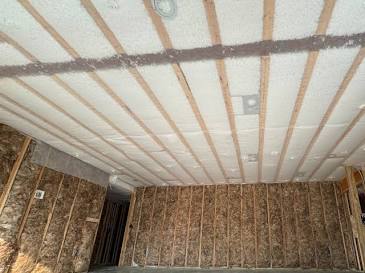
Filling accessible ceiling cavities is a practical opportunity while you are finishing a basement. Interwest nets the ceiling with mesh or netting secured by staples, then makes an opening in each cavity bay and blows it full of insulation. The chosen material and installation specification depend on the project.
This treatment can reduce airborne sound transmission as part of the completed floor-ceiling assembly. It should not be sold as a guarantee that footsteps disappear. A customer’s experience in one house does not establish the result for a different floor plan or ceiling construction.
Discuss impact noise before drywall
Ask your builder whether flooring and underlayment above, or an appropriately designed ceiling assembly below, should be part of the plan. Additional mass and systems that reduce direct vibration transfer may help, but their performance depends on the complete assembly and correct installation. These are separate construction decisions; do not assume an insulation estimate includes them.
If the floor upstairs is already finished, mention that constraint early. Likewise, low basement headroom or an existing ceiling can limit the practical choices. A room-by-room plan is more useful than adding material without identifying how sound travels.
What about an already finished basement?
Drill-and-fill may allow insulation to be added through planned openings. It still fills cavities; it does not turn the ceiling into a disconnected assembly. Existing insulation, blocking, fixtures, and ductwork affect access and coverage. Ask who closes the openings and who handles texture and paint.
What customers say
Read all 45 Google reviews →Cody and his family team did a great job helping me soundproof my basement ceiling, stuffing the joist bays with a really high density pack to cut down the noise.
Bring useful details to the estimate
Record where the noise happens, the rooms it travels between, and whether you mainly hear speech, music, footsteps, or a combination. Photos of the ceiling and any available framing photos help. If someone offers an STC or IIC rating, ask which tested assembly it describes. Those ratings do not belong to a bag of insulation by itself, and a laboratory rating is not a promise of identical performance in your home.
For background on sound ratings and complete assemblies, see National Gypsum’s acoustics questions and answers. Product and assembly test results should be read in the context of the construction they describe.
Browse all basement finishing guides
Explore basement ceiling sound insulation · See our Pleasant Grove basement project