
A homeowner-focused basement service
Basement Ceiling Sound Reduction
Basement ceiling insulation can substantially reduce voices, television, music, and other airborne sound between floors. Interwest will inspect the ceiling and recommend netted-and-blown insulation for open cavities or drill-and-fill when the ceiling is already finished.
The practical goal
Make the space below feel less connected to every sound above
A basement can become a family room, bedroom, office, playroom, or gathering space—but sound traveling between floors can make both levels less comfortable to use.
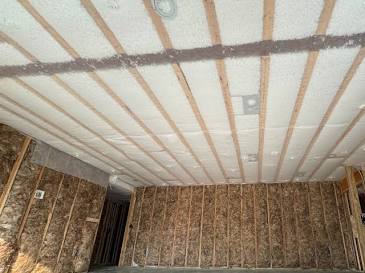
Filling open basement ceiling cavities with dense insulation absorbs sound energy and can make a dramatic difference in voices, television, music, and other everyday noise moving between floors.
A noticeable improvement in everyday sound. Dense cavity insulation helps the basement and the rooms above feel quieter, more comfortable, and more private.
Airborne sound and impact sound are different
Understanding the difference explains where ceiling insulation makes the biggest improvement.
Airborne sound
Conversations, television, music, dogs barking, and children playing begin in the air. Dense insulation in the ceiling cavities absorbs sound energy within the assembly.
Impact and structure-borne sound
Footsteps, dropped objects, moving chairs, and exercise equipment create vibration that can travel directly through joists, subflooring, walls, and other framing.
How the netted-and-blown approach works
- A support net is secured across the selected open ceiling framing.
- Insulation is blown behind the net and distributed through the selected joist cavities.
- The net holds the insulation in place across the treated area.
Your estimate identifies the material, coverage, installation specification, and treatment area recommended for the project.
Where basement ceiling insulation works especially well
This service is especially useful when:
- Your basement ceiling is open and the joist cavities are accessible.
- You are preparing to finish a basement and want to consider sound before drywall is installed.
- Conversations, television, or normal household activity travel noticeably between floors.
- You want the rooms on both floors to feel quieter and more private.
Tell us about the sounds and the ceiling
- Whether the main concern is voices, television, music, footsteps, or a combination.
- Whether the ceiling is open or already finished.
- Which rooms are above and below the treatment area.
- Whether open stairways, doors, or ductwork connect the two levels.
- Any moisture, wiring, access, or other building conditions we should plan around.
Open ceilings versus finished ceilings
Open ceiling
An open ceiling generally provides the most direct access to framing cavities and makes wiring, plumbing, ductwork, blocking, and fixtures easier to see before a scope is proposed.
Finished ceiling
Drill-and-fill places insulation through planned access openings without removing the entire ceiling. Include a few photos so we can plan the most practical approach.
If drywall or another ceiling finish is planned, tell Interwest when requesting an estimate so the insulation scope can be considered before the ceiling is closed.
What shapes the sound improvement?
- The type of sound you want to reduce
- The floor and ceiling construction
- The continuity and size of the treated area
- Joist layout and cavity conditions
- Ducts, plumbing, wiring, fixtures, and other penetrations
- Open stairways, doors, hallways, and adjacent rooms
- Flooring and underlayment above the basement
- Walls or framing that carry sound around the treated cavities
We use these details to recommend the most effective treatment for the basement.
What affects the price?
Project pricing can be affected by the total ceiling area, open versus finished access, framing configuration, ductwork and other obstructions, selected material and coverage, preparation, work-area access, and the agreed cleanup and completion scope.
A project-specific estimate is more useful than an unsupported general square-foot price.
Basement sound-reduction questions
Is basement ceiling insulation the same as soundproofing?
Basement ceiling insulation is an effective sound-deadening upgrade. Filling open ceiling cavities can make a noticeable—and often dramatic—difference in airborne sound such as voices, television, and music, helping the rooms on both floors feel quieter and more private. Complete soundproofing requires treatment of the entire floor-ceiling assembly and the other paths sound can travel, but insulation alone can be a very worthwhile improvement.
Will it stop footsteps from the floor above?
Basement ceiling insulation can soften some footstep noise and make the room below feel significantly quieter overall. Its strongest benefit is absorbing airborne sound such as voices, television, and music. Footsteps and dropped objects also send vibration through the framing, so they may not be eliminated by insulation alone. We explain that difference so you know where to expect the greatest improvement.
What does netted-and-blown mean?
Netted-and-blown is a thorough way to fill open ceiling cavities for sound control. We fasten durable netting across the joists, then blow insulation behind it so the selected cavities are filled evenly. Interwest will inspect the space and recommend the best approach; when the project allows, we prefer cellulose because its density helps absorb voices, television, music, and other everyday airborne noise.
Should this work be done before drywall?
Yes—before drywall is the ideal time whenever practical. Open cavities make it easier to install a full netted-and-blown treatment before the ceiling is covered. If the ceiling is already finished, drill-and-fill may still offer a solution through planned access openings.
How much does the work cost?
Every basement receives project-specific pricing based on the ceiling area, access, framing, obstructions, selected material, coverage, preparation, and completion scope. Interwest will provide a clear written estimate for the actual space so you can see exactly what the price includes. Review the factors that shape an insulation estimate.
Where this service is available
Utah County, Salt Lake County, and the Wasatch Back
- All Utah County
- All Salt Lake County
- Park City
- Heber City
- Kamas
- Midway
- Hideout
- Oakley
Interwest regularly works throughout Utah County, Salt Lake County, and Wasatch Back communities and also travels to other nearby Utah communities.
Start with your basement
Make Your Basement Noticeably Quieter
Tell us about the ceiling, the area involved, the rooms above and below, and the sounds that concern you most. We’ll recommend the best next step.
Google customer reviews
See why Utah homeowners recommend Interwest
Customers consistently mention responsive communication, careful work, professionalism, and results they are glad to recommend.